
Grace for Hurting Families
Because hurting families are the only kind that exist, and,
Because the grace of God is what we all need.
See you in the Lord’s House!

Grace for Hurting Families
Because hurting families are the only kind that exist, and,
Because the grace of God is what we all need.
See you in the Lord’s House!
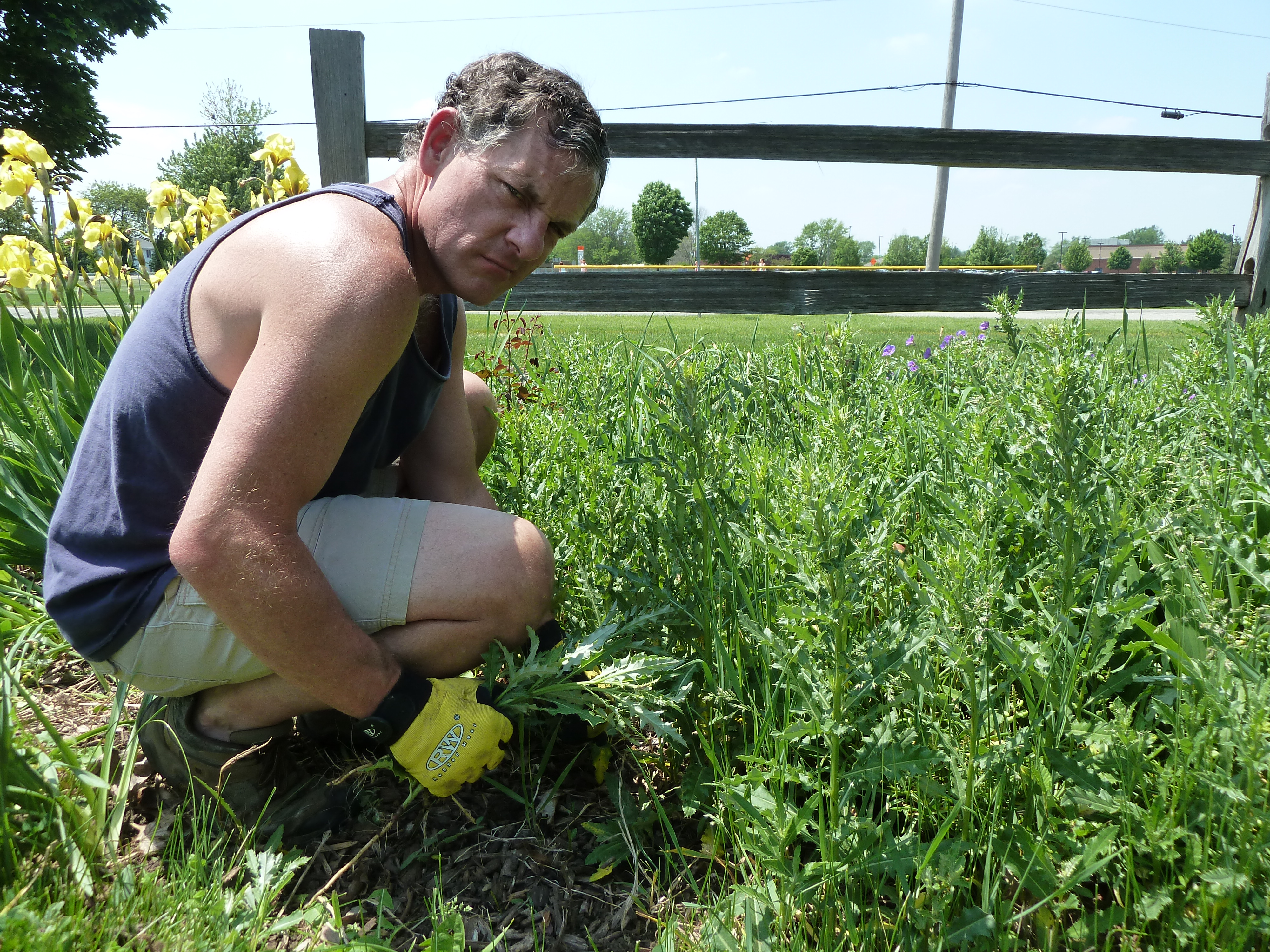
I hate weeds. It’s the bane of my life since my wife loves to garden without weed-killer. Do I have to pull weeds? Cheryl says yes. But that’s not really my question. I mean, “Why are there weeds for me to pull in the first place?”
And there you have it! Because in the first place there was supposed to be trust in the Lord’s provisions along with managing the ground. I once had it made in the shade. I once had the privilege of hard work without any opposition from the ground. But all that was forfeited when I said goodbye to God. Adam, our head representative of the human race, along with his wife, said adios to God in the garden. They wanted to live life on their own terms, make their own rules, supply their own need, sustain their own livelihood, and graduate themselves to the very top, declaring themselves as their own gods. Then what happened?
What do you get when you try to do life apart from the author of life?
“The LORD God took the man and put him in the garden of Eden to work it and keep it (work came before sin, i.e., work is not the consequence of sin). And the LORD God commanded the man, saying, ‘You may surely eat of every tree of the garden, but of the tree of the knowledge of good and evil you shall not eat, for in the day that you eat of it you shall surely die” – Genesis 2:15-17.
Notice that God did not say, “you eat from that tree and I’ll kill you.” God said that you will die. Death is a just and natural consequence of trying to live without the giver of life. Man cannot take the place of God – he cannot be man and attempt to be God, to know and sustain fully all that there is to know and sustain about good and evil. But he tried. And trying, he died. Man went down and weeds came up. They came up against his sweaty face to tell him – “this is your fault”:
“. . . cursed is the ground because of you; in pain you shall eat of it all the days of your life; thorns and thistles it shall bring forth for you; and you shall eat the plants of the field. By the sweat of your face you shall eat bread, till you return to the ground, for out of it you were taken; for you are dust, and to dust you shall return” – Gen. 3:17b-19.
Both my body and the ground are cursed. Those wretched annual weeds remind me of this. But the curse of weeds will not be overturned by man. Someone must come along and live out the obedient, trusting, hard-working life that the first Adam abandoned. And that someone is none other that the weed-busting Jesus who is the bread of life. Adam got a hint of this when he was given grace and mercy to “eat bread” till he returned to dust. Bread does not come from weeds but from wheat. Jesus would undergo the curse as the bread of life – he would die my death, suffer my curse, but come up out of the ground without the infection of the curse, not like a poisonous and obnoxious weed, but as sweet satisfying bread. Weeds are man’s fault. Bread is God’s mercy.
So pull a weed today and eat some bread. Own one and give thanks for the other.

I recently made this statement in a funeral where a sister in Christ went home to be with the Lord via ALS (Lou Gehrig’s Disease) at the young age of 55.
This is what I mean to say, when I say “I have more questions than answers”:
1. The infinite character of God leads me to acknowledge that I presently know very little compared to what can be known. If eternity future is described as a never-ending discovery of the “unsearchable riches” of Christ, and there will never come a day when I will say, “Is that all?” – then my questions outnumber my answers. The apostle John said that the world cannot contain the books that could be written of the short 33 years of Christ (John 21:25). And John Newton said that after 10,000 years with the Lord in the new heavens and new earth, “we’ve no less days to sing God’s praise than when we’d first begun.” In other words, after all that time you will not have used up a single day, a single reason to say, “only 9,999 days left to enjoy God and then it’s over – there’s nothing left to explore.”
2. The finite character of Man leads me to acknowledge that I presently know very little compared to what can be known. You don’t need scripture to believe this. Look around you and explain fully all that you see. Can you? Can you explain what all the research hospitals are still trying to learn? Can you explain why musicians can still write music with only 12 notes to work with? Think of it: hundreds of thousands of new songs will be written this year in dozens of genres and still not exhaust the infinite possibilities of just 12 notes. Can you explain that? Do you comprehend the thousands of life-sustaining activities that your body will perform this day to keep you alive? The immune system alone will perform hundreds of jobs while you read this post so that you don’t drop dead before you’re finished. Do you get that?
Job was asked 77 questions by the Lord of Heaven and Earth and he could not answer a single one. Which means that Job has more unanswered questions to deal with than answers. This was his confession. (Job 42:1-6)
However, if you have more answers than questions, or very few questions, then,
1. You are nearly as knowledgeable as God is, or,
2. You don’t care to know what you don’t know. You’re too prideful to ask. You don’t ask because either you think you know it all or you really do. Do you really know it all?
But this is what I do not mean to say, when I say “I have more questions than answers”:
I do not mean to say that I am uncertain about what I already know to be true and the source of which I am certain about truth. There are some things that we can know for certain. Like jumping out of an airplane without a parachute may feel good momentarily, but not for long. Like taking a right turn off the Interstate to drive up an exit merge ramp – it might be quicker to get back on track but watch out for that head-on collision. Like drinking bleach. Like storing pennies in your ear (that’s not what that orifice was made for!). I am certain about thousands and thousands of things because there are that many things that can be known. Especially, I know that my redeemer lives, and that one day he will stand again upon the earth (Job 19:25). Job suffered terribly and never did find out the full purpose of his suffering. But that does not mean that suffering has no purpose. It just means that you might not know in this lifetime all that there is to know about suffering. I also know for certain that God is able to guard my faith through all suffering and bring it to a completion when my life expires (2 Tim. 1:12; Phil. 1:6).
I have more questions than answers. But I have Jesus too – and so does our sister in Christ! And he’s more than enough to satisfy our quest for knowledge without exhausting the quest. Our desire to know is evidence that there is something more to be known.
The best way to honor those who have served our country in death is to worship Jesus Christ, freely gathered in the house of the Lord. If you’re thankful in any way at all for what little religious freedoms remain in America, then use that freedom today to safely assemble for worship without threat of government. You cannot complain about loss of freedoms when you choose to abstain from the very thing that best displays a free democracy. You’ll be glad you went into the house of the Lord – for in Christ alone is freedom truly found.
See you in church!

For those who love Jesus Christ as their Risen Lord and Savior, death is no longer a threat to our humanity. Since we are physical and spiritual beings, neither one nor the other, but whole beings who inwardly know there is more, we long to escape what is taking away our lives. But we can’t overrule our own death. This is why Jesus did. Jesus overruled the threat to humanity by defeating the sentence of death for everyone who knows their need of him.
In Christ, it is not death to die. It is the door to eternal life.

Truth is, some people are never satisfied – with anyone or anything. They either have too high an expectation, or an unrealistic expectation, or mostly, a deep inner need to feel perfect about themselves by finding fault with you – no matter what! The only time that they are ever happy is when you’re not. And that is what validates their superiority over you. It is their attempt to control and manipulate through emotional abuse.
This is how the Pharisees lived and this is how Jesus put it:
“To what then shall I compare the people of this generation, and what are they like? They are like children sitting in the marketplace and calling to one another,
‘We played the flute for you, and you did not dance; we sang a dirge, and you did not weep.’
For John the Baptist has come eating no bread and drinking no wine, and you say, ‘He has a demon.’ The Son of Man has come eating and drinking, and you say, ‘Look at him! A glutton and a drunkard, a friend of tax collectors and sinners!’ Yet wisdom is justified by all her children.” (Luke 7:31-35).
Jesus said that some people can’t ever be satisfied. If you play a happy song for them, they do not respond appropriately and dance. If you sing a sad song for them, they do not respond appropriately and weep. No matter what you say or do, they never join in but only stubbornly and scornfully stand at a distance, giving you another failing grade. They are unappeasable. And for Jesus, this was his proof:
John the Baptist was under a Nazarite vow and lived an ascetic life, depriving himself of normal pleasures. He did not manicure himself and he lived in a desert, ate like a wild animal robbing honey from bee hives, ate locusts (crunch crunch), and did not drink wine. The Pharisees looked at all this self-depriving and pursuit of solitary time with the Lord as demonic – they said that John the Baptist was demon possessed and therefore rejected his message “repent for the Messiah is coming.”
Jesus on the other hand, came on the scene like a normal Joe. He dressed and took care of himself like most people do, he ate regular food and drank wine. He did nothing out of the ordinary as he healed and proclaimed that the Kingdom of God had arrived in him. But the Pharisees again started the name-calling, and tagged Jesus as a glutton, an over-eater of food, and a drunkard, an over-drinker of wine. True, if Jesus had eaten too much food he would be a glutton, and if he drank too much wine he would be a drunkard. But neither accusation was true, but only fabrications to reject him.
No matter what, no kind of living from those sent by God satisfied the Pharisees, except their own. Truths said in love never pleased the religious elites and cultural gatekeepers of society. The Pharisees were the self-appointed gurus who perched themselves over society, with smugness telling everyone else how to live, calling people names, and threatening others with punishment if they speak out against their established, hypocritical dictatorship. And therefore,
As a Christian, no matter what truthful thing you say with the most loving and respectful attitude and tone, you still will be called a homophobe, a bigot, a man-hater, a freak of nature, a worthless piece of human excrement. You will be threatened, ostracized, fined, fired, demoted, flunked, and kicked out. But with God’s grace and power of the Holy Spirit to guide your path, stay the course, do not retaliate, do good to those who mistreat and persecute you, and you will see that in the end, that “wisdom is justified by your children.” Meaning, the offspring and produce of living a wise life in Christ will prove in the end to have been the right path. And those who nit-picked you apart for every single fraction and discounted your very life as worthless, will in the end face Jesus himself – and then he will have the last word.
As for me, I will keep hanging around the untouchables of society like Jesus did, to tell them of a joyful life in Christ with sins forgiven. While others reject, some will accept. Some people will always be disappointed with you, like they were with Jesus. But others will hear the gospel as the good news that it really is. They will love Jesus with all their heart, just as the discredited woman did as she wept with joy at Jesus’ feet, while Simon the Pharisee continued on his path of self-destruction (Luke 7:36-50).

Below are some of the things I said yesterday in my Mother’s Day Message. I hope you are encouraged.
“Are You My Mother?” is the title question for one of our favorite children’s books we read to our children when they were young. With a baby bird wandering through life asking a dog, a cat, a machine – “Are You My Mother?” the little bird searches for what it believes to be true – there must be a mother for me.
But a deeper question is irresistible: Who am I and how did I get here? I would not care to know who my mother is and to know her if I did not want to know my own identity as a human. Our self-understanding of who we are is connected to who birthed us.
With respect to the question pursued in the children’s book, “Are you my mother?”, Drema Kay Truman is the only human on the planet of whom I can say, “she is my mother – she gave birth to me.” As a child, she was my parent but not merely my parent. A grandmother, or aunt, or a consenting adult could be regarded as my parent but no one else can be my mother in the sense of saying, “she gave birth to me.” Only a female can give birth. I exist because a female gave birth to me. Furthermore, I exist because a female and a male loved one another in a marriage union that safeguarded what is ideal and best for children to flourish under. I exist because of one female and one male. Not two females, not two males, not one female, not one male, but because of one female and one male in marriage.
Our identity and self-understanding of who we are as living creatures cannot be explained by merely saying that we have parents. We must say, by necessity, that “I am here because I have a mother and a father who bore me.”
Here are five things that God gave me when he gave me my mother:
1. When God gave me a mother He gave me an explanation for my existence. In no way do I attempt to lessen the sorrows of those who do not know their mother and father. But only to point out that there is an irresistible tug on the heart to know who gave birth to you. I want to know where my physical life began. Why? I want to know how I got here. My mother had me, and her mother had her and her mother’s mother had her mom – until you are back here in Genesis one: “So God created man in his own image, in the image of God he created him; male and female he created him.” (Gen. 1:27).
As my mother is the source of my reality, in part, there is also a voice of truth that speaks down through the pages of time that explains all reality: ‘In the beginning God created the heavens and the earth – and I made you for my own glory and for our everlasting joy together.’
2. When God gave me a mother He gave me an explanation for my self-identity. Not only do I want an explanation, a point of reference for my existence, but, ‘Who Am I?’ is answered by “made in the likeness of God” but not apart from likeness of mom and dad. In Gen. 4:25-5:5, Moses writes that we are made in the likeness of God, then says that Adam fathered Seth, “a son in his own likeness, after his image.”
Seth looked like Adam and Eve (one flesh union, bone of my bone). I look like my mother and father. As a child grows up he or she begins to make the connection that the features on your face are similar to the features on daddy’s face, and similar to the features on mommy’s face. You also come to realize that, as a boy, I am more like my daddy than my mommy, I am male like my daddy is male. As a girl, I am more like my mommy, than my daddy. I am female, like my mommy is female.
Furthermore, God named the male man, Adam, and Adam named the female man, “woman” – then named her Eve after the fall into sin, then we see Adam naming his son – Seth. Point: I did not and you did not come into this world with a name tag already embedded in you. You did not come pre-stamped for delivery with a name tattooed on your behind. You had no point of self-reference by which you could say who you are.
Naming is very important in scripture. It teaches my heart that my identity is a bestowed one from a higher level of authority over my life for my good. Since my mother gave birth to me, it teaches me that I need another kind of rebirth – I need to be born again. But I can’t birth myself into the kingdom of God anymore than I birthed myself alive in 1964. Also, my mother named me because she is the source of my life and has authority over it. This is partly why Jesus wants us baptized into the name of the Father, Son, and Holy Spirit. It demonstrates ownership for ones well-being. As a child, I derive all of my understanding of who I am from my mother and father.
3. When God gave me my mother, He gave me an explanation for my role as a male man, which also includes female man. This is a complementarian view of male and female relationships and roles.
“Then the man said, This at last is bone of my bones and flesh of my flesh; she shall be called Woman, because she was taken out of Man. Therefore a man shall leave his father and his mother and hold fast to his wife, and they shall become one flesh. And the man and his wife were both naked and were not ashamed.” (Gen. 2:23-25)
This does not mean that singleness is a lesser kind of existence. The examples of God-honoring singleness are many in Scripture – especially Jesus himself. But in terms of how I am to function so that the human race goes on, it goes on through leaving a mother and father and taking a wife, therefore multiplying and filling the earth with a few more lovers of Jesus Christ. Not just filling the earth with more humans, but impacting, influencing the human race with children who live their lives pointing the way to our Creator who sent his son.
It is a logical deduction for children to easily get: my mommy had me . . . one day, I will leave, get a female and have children, like my daddy left his mommy and daddy and married my mommy, who left her mommy and daddy. It’s that simple!
4. When God gave me a mother He gave me an explanation for my miserable end.
“You may surely eat of every tree of the garden, but of the tree of the knowledge of good and evil you shall not eat, for in the day that you eat of it you shall surely die” and “By the sweat of your face you shall eat bread, till you return to the ground, for out of it you were taken; for you are dust, and to dust you shall return.” (Gen. 2:16-17; 3:19)
Death strips away my existence and my self-identity and my family. Dust has no eye-color, fingerprints, or bodily features. My mother and father are dying – everyone’s mother and father are dying. You are dying. I am dying. I am not a god, I am a human like my mother and father is human. My future has finality in it. You and I will come to a final end – to dust. We may not like the explanation – but at least it is the truth. The human race dies because we all exchanged a promise for a lie. God promised us joy and provisions and blessings in living for him, the Devil suggested a lie that said we could have it all on our own terms without God. Death is the answer to our question: Can I be God? Evidently not.
Which leads us to this final blessing that when God gave me a mother . . .
5. He gave me The Answer for my need and longing for everlasting life.
In order to hear the good news you have to believe the bad news. Death does not have to have the last word. Believe it. But believe this too: When you consider your own mother who birthed you into this world, you should believe that there is another birth that is offered to you – one that will restore all that is lost. Jesus Christ, the seed of the woman (Gen. 3:15) crushed the head of the Devil and his offspring on the cross. God offers clothing of righteousness for your sin – he has provided the righteousness of his own son so that you are not exposed and naked before him (Gen. 3:21).
Adam renamed his wife, “Eve” – the mother of all living. Her seed was born through a virgin girl named Mary – his name is Jesus, “for he will save his people from their sins” (Matt. 1:21). Question: When you think about your mother who birthed you into existence, do you think about how you are going to live forever, given the fact that your mother is going to die and so are you?
This is what it means to contemplate the mystery of your own existence through your birth-mother. It guides me to think about the one who made my mother and made me so that I can hear the good news of Jesus Christ.
Happy Mother’s Day Mom!
I love you and thank the Lord for giving you to me as my mother.

Spread some grape jelly on an orange and what do you get? A Baltimore Oriole. I look forward to this time of the year when you can lure these beautiful creatures to your back yard in Northern Illinois for about a month until the mulberry trees bloom, then they disappear for another year.
There was a time that I wouldn’t give a hoot about birds:) – I must be getting old. As years go by what should happen is perspective – it should widen with more and more appreciation for what is lovely:
“Finally, brothers, whatever is true, whatever is honorable, whatever is just, whatever is pure, whatever is lovely, whatever is commendable, if there is any excellence, if there is anything worthy of praise, think about these things” – Philippians 4:8.
Our Lord wants our hearts stirred to worship him through whatever there is that stirs affections and perspective of the grandeur of the world we live in. It can be anything that is true, honorable, just, pure, lovely, commendable, excellent, and worthy of boasting about. Our world is filling up with the exact opposite of what is lovely and pure. So it is incumbent upon the believer in Christ to stay focused on anything that incites wonder, so that you can say more and more as the years go by,
“God must be a beautiful God to make such a lovely bird.”

Sickness and disease in the body tells us that there is something wrong with the world we live in. We do not accept our brokenness as normal – we fight back against the perennial deterioration of the body and mind; we will even apply cream to fight wrinkles! Clearly, we do not go silently. And we will do what might seem absurd: We will pray for healing. But not like your evening news anchor who invokes the sentimental, “they are in our thoughts and prayers,” as a tag at the end of a sad story. No, we will pray to a real person who hears and answers prayer according to what is not only best for us, but what is the best way to display his grace and mercy in our lives.
As our family and friends wait for news this day on whether the radiation had some success in treating my father’s liver cancer, I want to be encouraged by answering my own questions:
To whom did I pray over the past months? I prayed to the one who created me and sent his son to rescue me from my sins and the consequences of my sins:
“The God who made the world and everything in it, being Lord of heaven and earth, does not live in temples mad by man, nor is he served by human hands, as though he needed anything, since he himself gives to all mankind life and breath and everything . . . he has fixed a day on which he will judge the world in righteousness by a man who he has appointed; and of this he has given assurance to all by raising him from the dead” (Acts 17:24-25, 31). “For I consider that the sufferings of this present time are not worth comparing with the glory that is to be revealed to us . . . creation itself will be set free from its bondage to corruption . . . we ourselves, groan inwardly as we wait eagerly for adoption as sons, the redemption of our bodies . . . the Spirit helps us in our weakness. For we do not know what to pray for as we ought, but the Spirit himself intercedes for us with groanings too deep for words” (Romans 8:18, 21, 23, 26).
What is prayer? It is the yearning of the soul that speaks to him who made us. “For this reason I bow my knees before the Father, from whom every family in heaven and on earth is named, that according to the riches of his glory he may grant you to be strengthened with power through his Spirit in your inner being . . . to know the love of Christ that surpasses knowledge, that you may be filled with all the fullness of God. Now to him who is able to do far more abundantly than all that we ask or think, according to the power at work within us, to him be glory in the church and in Christ Jesus throughout all generations, forever and ever. Amen.” (Eph. 3:14-16, 19-21)
What can I expect? I may expect one of three things when praying for healing:
1. Healing without medicinal intervention. Jesus may heal outright with a command that reverses the effects and consequences of living in a fallen, sinful world (Luke 5:17-26; Acts 5:12-16).
2. Healing with medicinal intervention. Jesus may use the things of the earth to signify that healing often comes by means (John 9:1-7; 1 Timothy 5:23).
3. Healing that comes after death, but not until then (2 Cor. 12:9-11). Jesus promises to make all things new for those who love him. “He will wipe away every tear from their eyes, and death shall be no more, neither shall there be mourning, nor crying, nor pain anymore, for the former things have passed away” (Revelation 21:4).
Which means that for those who know the Lord, the answer is emphatically, “you will be healed of all your diseases.” It’s just a matter of time!
Is this real and how do I know?
1. It is an inherent desire among humans to be rid of all sickness and death. Let Darwin die with his lie that weakness leading to death is a “natural part of the evolutionary process of producing a stronger race.” Fiddlesticks!
2. People are healed and are healing all around us. If you think this is just coincidence, you should consider the stunning odds that more of us are not in the hospital or dead, considering the massive amount of ways the body can just shut down and die at any moment. The one who holds the universe in his hands is holding your breath this very moment.
3. Because there is on record, with full disclosure and eye-witnesses who gave their lives to say so, that Jesus was crucified, buried, and on the third day rose again from the grave. Since this is true, the one who is in Christ can mock death and all that threatens death: “O death, where is your victory? O death, where is your sting? The sting of death is sin, and the power of sin is the law (meaning, the consequence of loving sin over Christ is the penalty of death. But Jesus died a sinless man and therefore his Father acquitted all who love his son, freeing them from the law’s penalty), but thanks be to God, who gives us the victory through our Lord Jesus Christ” (1 Cor. 15:54b-57).
Now what?
I wait with hope in God!
 the sound board